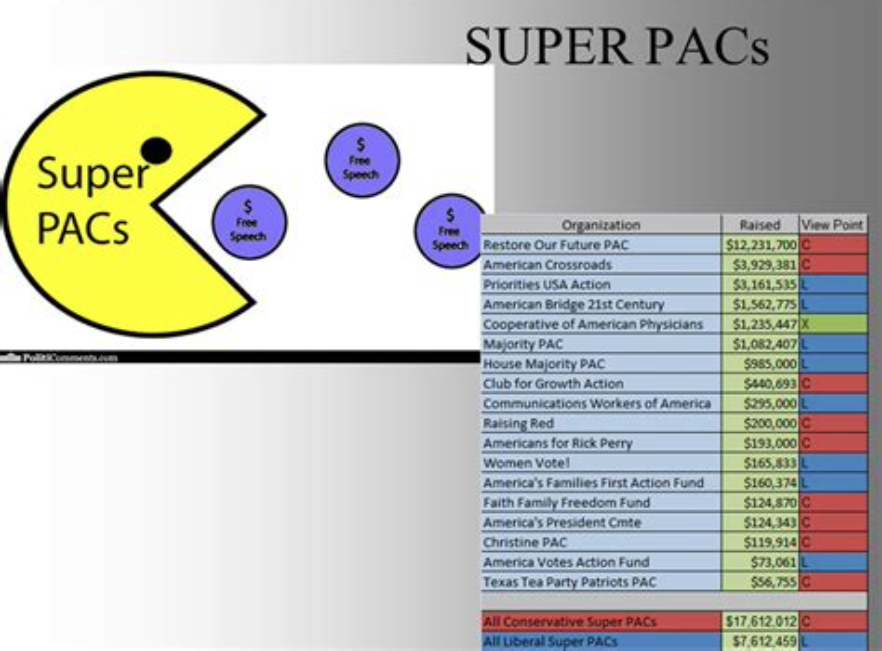

Every single issue that’s important to us as Americans gets corrupted by the way we fund campaigns. Now, the problem is the money is not coming from the average American. It’s not like all of us are giving money to these candidates. Instead, they’re raising this money from the tiniest fraction of the 1%. American politics have fundamentally changed over the last 14 years.
This is going to be the most expensive election year ever. Super PACs can raise an unlimited sum of money with very few restrictions. They’re like these breathing monsters inside Congress right now.
Many people don’t remember that until 2010, the Republican Party had a very aggressive climate change platform. But in 2010, when super PACS became legal, almost overnight, the Republican Party went from a party trying to address a very difficult problem in good faith, to a party that denied there was even such a thing as climate change.
But now, super PACs have a new challenger, a group in Maine with a radical idea.
The Watergate scandal under President Nixon prompted an investigation into his reelection campaign. American Airlines has admitted it made illegal corporate contributions to President Nixon’s reelection campaign. Nixon was very focused on winning, not just in a small way, but in a dramatic way.
There’s a famous example of a bunch of milk producers who were upset with milk price controls. These milk producers met with Nixon and illegally offered $2 million to help his reelection campaign. And surprise, surprise, within a very short period of time, Nixon announced his change in his policy about milk price regulation.
Then in 1974, the Supreme Court put limits on donations. In Buckley, the Supreme Court said, well, it’s okay to limit contributions to a campaign because the fear is there’ll be some quid pro quo bribery. So the reason we have limits on how much you can contribute to a candidate is because if you could give $20,000 to a candidate, the risk of quid pro quo corruption would be greater.
But the Supreme Court overturned the limits on what campaigns and outside groups could spend in an election. This meant that while an individual could only donate up to $1,000 to a candidate, the candidate and their campaign could spend as much as they wanted. What it did is it created this really horrific incentive, which is every candidate started to spend all their time fundraising.
There’s one key question, could you give unlimited amounts of money to a committee that’s going to spend money independently of a campaign? So it’s not about the spending, it’s about the contributions. Two months after Citizens United, the D.C. Circuit Court took a case in which it took Citizens United and interpreted it to mean that any donations to a committee that makes independent expenditures couldn’t be limited. Now at the time, people didn’t care much about the decision. The United States government decided not to appeal it to the United States Supreme Court because they didn’t think it was going to be significant. But this was the decision that caused the proliferation of super PACs.

Now, you know, a handful of billionaires can contribute hundreds of millions, even $1 billion into an election cycle. Instead of the category of people who can give between $2,000 and $5,000, you now have the people in the stratosphere who are totally disconnected from life. The big super PAC donors don’t care about public education, basic health care, basic infrastructure.
In 2024, 97% of super PAC money came from just the top 1% of donors.
Now a policy to curb the unchecked power of billionaires and corporations is on the ballot in Maine. It’s a very short question on the ballot, you know, do you want to limit to $5,000 the amount that a political action committee can accept from an individual or corporation? The argument is not that we’re trying to suppress the amount of money in politics. We’re trying to avoid raising money in a way that creates the risk of quid pro quo corruption.





Leave a Reply