
On March 22, 2021, a lone gunman opened fire in a grocery store in Boulder, Colorado, killing 10 people. In the days following, politicians responded as they often do, offering thoughts and prayers to the victims’ families. However, the U.S. House of Representatives decided to take action, approving HR8, a bill for universal background checks, with a vote of 240 to 190. Background checks have consistently been a popular policy, polling over 90% approval, so it wasn’t surprising that the House passed such a widely supported solution. What was surprising was what happened next—when the bill went to the Senate, it faced a 50-50 partisan split: 50 Democrats and 50 Republicans. While Democratic politicians generally favor background checks and Republicans typically oppose them, several Republicans, like Susan Collins, Pat Toomey, and Lindsey Graham, supported the legislation. Despite this support, the bill failed to pass in the Senate.
The simple fact is, the setup of the senate often makes it difficult to pass legislation. In a hypothetical example, if a law supported by 70% of Americans is opposed by 30%, and that 30% is concentrated in smaller rural states, the bill would likely pass the House but fail in the Senate due to the overrepresentation of these smaller states. This scenario isn’t just hypothetical—it happens frequently, with popular bills passing the House only to die in the Senate.
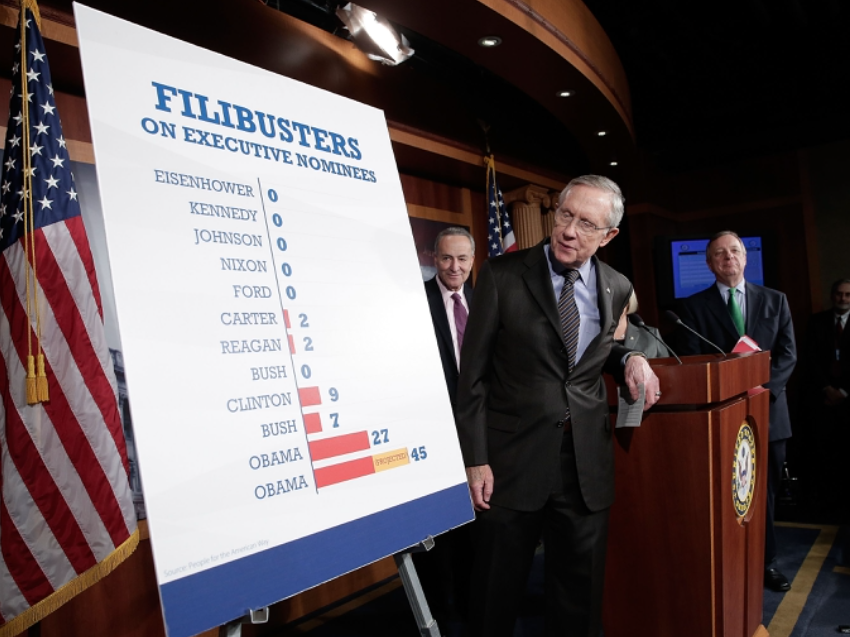
It gets even harder with the filibuster, a loophole in the Senate’s rules. According to the Constitution, the Senate can’t vote on a bill until debate ends. Senators realized in the early 1800s that they could stall legislation by giving long speeches to prevent a vote. In 1917, the cloture rule was introduced, allowing debate to end if two-thirds of the Senate agreed. The threshold was later changed to three-fifths, or 60 senators. This means that even if a bill has 59 senators supporting it, it can still be blocked by the filibuster.

The situation worsened in the 1970s when the Senate introduced the two-track system, which allowed the Senate to sideline a filibustered bill and move on to other business without requiring speeches. This made it easier for the minority party to block legislation without even having to speak on the floor. Given the current political gridlock, it’s rare for either party to control 60 Senate seats. Even when they do, one defector can prevent a bill from passing, as seen in 2010 with the Affordable Care Act, when Joe Lieberman’s opposition forced Democrats to drop the public option.
Abolishing the filibuster is one solution that has gained bipartisan support. During Obama’s presidency, the filibuster was removed for lower court judges, and during Trump’s presidency, it was removed for Supreme Court appointments. Now, many believe it should be eliminated for all legislation, which would allow Congress to pass bills more effectively and represent the American people’s will more accurately.






Leave a Reply