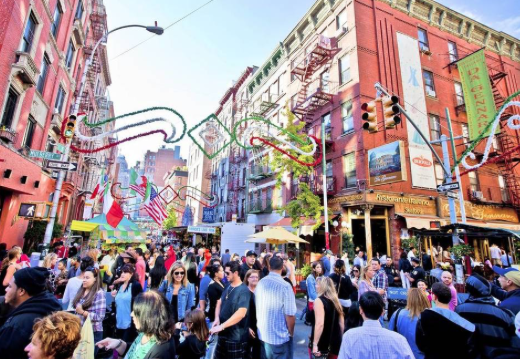
Every September, Mulberry Street in the Little Italy neighborhood of Manhattan turns into a feast, that is, the Feast of San Gennaro. The Feast started in 1926 as a religious festival that was dedicated to the Patron Saint of Naples. Now, it is one of New York City’s most well-known ethnic heritage festivals. It is known in the popular imagination as being a place full of food stalls, parades, and street entertainment. Beyond just this, though, the San Gennaro Festival also is a way in which the political history and civic integration of Italian-Americans in New York City can be observed.
The Feast of San Gennaro was started by Neapolitan immigrants in the city who wanted to preserve and bring their religious traditions with them to New York. Their traditions were rooted in parish life, therefore the early versions of the festival reinforced notions of spiritual devotion and communal solidarity during a time when Italian immigrants were dealing with widespread discrimination and marginalization. As time passed, the festival moved on beyond just its religious origins in order to showcase itself as being a showcase of ethnic identity.
Italian-Americans more and more became incorporated politically into New York City’s social fabric. The San Gennaro festival provided a space by the middle of the 20th century in which local leaders could interact directly with members of the Italian-American community. Political figures such as Mayor Fiorello La Guardia and Governor Mario Cuomo made appearances at the Feast, signifying its place as a religious, civic, and political function. Therefore, the festival worked to showcase just not aspects of cultural resilience, but also political presence.
The San Gennaro Festival showcases how ethnic celebrations also may function as ways in which immigrant communities can politically leverage themselves. By becoming visible in large urban spaces, Italian-Americans have been able to showcase their identity in neighborhoods such as Little Italy, Bensonhurst, and Belmont. Therefore, the Feast becomes a performative assertion of cultural continuity as well as political legitimacy.
The intermingling of cultural heritage and political agency can be seen at the Feast. Little Italy has changed over time. Italian-American residents in the neighborhood have declined, and new immigrant groups have moved in. However, the Feast continues to bring in significant attention from municipal offices around the city. The persistence of this local event showcases to the public how ritualized celebrations can function as a form of cultural memory, and also as a symbolic resource for ongoing political recognition and visibility.
The San Gennaro Festival continues to showcase the importance of immigrant identity within the broader sphere of New York City. For the Italian-American community, the Feast showcases integration taking place. It showcases cultural vibrancy, which then has allowed for Italian-Americans to affirm their belonging overall in the city and create a claim to having a civic influence. From a contemporary perspective, the Feast works as a tourist-oriented spectacle and also as a living testament showcasing the resilience of the immigrant community.
Ethnic festivals, then, work as a mediation between tradition and transformation. They are a site of embodied memory while also being an adaptation to the demands of a highly globalized city that prioritizes multiculturalism at its center. San Gennaro, then, exemplifies the political significance of cultural performance within immigrant histories and communities.
The San Gennaro Festival is not just a street fair. It is also a cultural event that is deeply entwined with the political heritage and history of Italian-Americans in New York City. By serving as a platform which encompasses communal solidarity, political visibility, and cultural continuity, the Feast showcases how Italian-Americans moved from being marginalized immigrants to established participants in the civic life of the city. Therefore, the Feast showcases itself as being a case in which immigrant communities use cultural expression as a way in which they can politically integrate and have influence.




Leave a Reply